
It's a jungle out there. With fake news left and right and uncertainty at a seemingly-all-time-high, it takes some work to remain grounded. So, let's check that we're on the same page,
Proposition 1: A primary job of an executive is to make decisions.
Proposition 2: The quality of our decisions depends on the quality of the information we collect, which depends on the quality of the questions we ask.
Therefore, asking better questions will get us to make better decisions and, by extension, do a better job as executives.
So far, so good?
Asking better questions is critical to making good decisions
Great, then we're in the business of asking better questions, a topic that my colleague Frédéric Dalsace and I have been researching for several years.
We've summarized some of our findings in a 2024 HBR article. In short, we contend that five types of questions can help during the decision-making process—investigative, speculative, productive, interpretive, and subjective. Each brings a different perspective, therefore each has its own utility. You can find out what your question mix (what your preferences are) by taking the self assessment here.
Most executives we speak with report that they never have all the time they'd like to ask questions. Take board members, for instance. Any board member might be able to ask a handful of questions at most during any one board meeting. Therefore questions have a cost of opportunity: Any question we ask is also a plethora of questions we don't ask. Which creates a hard tension.
In our work with many top teams, we've found that it's already challenging to "disengage the autopilot" during decision meetings; that is, it's hard for any of us to refrain from asking questions that feel safe, comfortable, or that have served us well in the past to make the time to ask the questions that will best serve the decision at hand.
But what happens when you partner up with an LLM?
LLMs use markedly different question mixes
In late 2025, we've put 13 leading LLMs to the test. We asked each one to take our LQM self assessment—the same we use for executives—200 times. We then compared the results with those of 1,600 executives who have taken IMD programs. For reference, these are seasoned mid- to senior-level executives with at least fifteen years of professional experience and often considerably more.
We (together with our colleague José Parra-Moyano) published our results in a hbr.org post, but the post didn't include the detailed results, so here they are.
The self assessment asks the respondent to indicate their preference by comparing the five types of questions pairwise. Each respondent starts with 100 points that get allocated according to their responses. We then average out results across respondents.
The top line in the table refers to executives—1,674 of them. The boldface figure is the average. So, executives allocated 20.6% of their 100 points to investigative questions, 21.4% of their 100 points to speculative questions, and so on. The figure next to it is the standard deviation.
We repeated the same operation with 200 instances each of 13 leading LLMs. When the average score was below that of executives, we colored it in red; above got a green color. So, opus 4.1, for instance, allocated 17.9% of its 100-point capital to investigative, which is lower than the 20.6% allocated by executives, hence the red color. For the LLMs, we also indicated the standard deviation.
The row below the results for each of the LLMs is a test of significance. Since the data is compositional (giving more points into one category implies giving fewer points in another), we took the log-ratio transforms, and since the transforms weren't normally distributed, so used a Wilcoxon test (in lieu of a standard t-test). Cells with a yellow background are those with a significance level of 5% or less compared to humans. All told, 75% (49 out of 65) of the points of comparison were statistically significant.
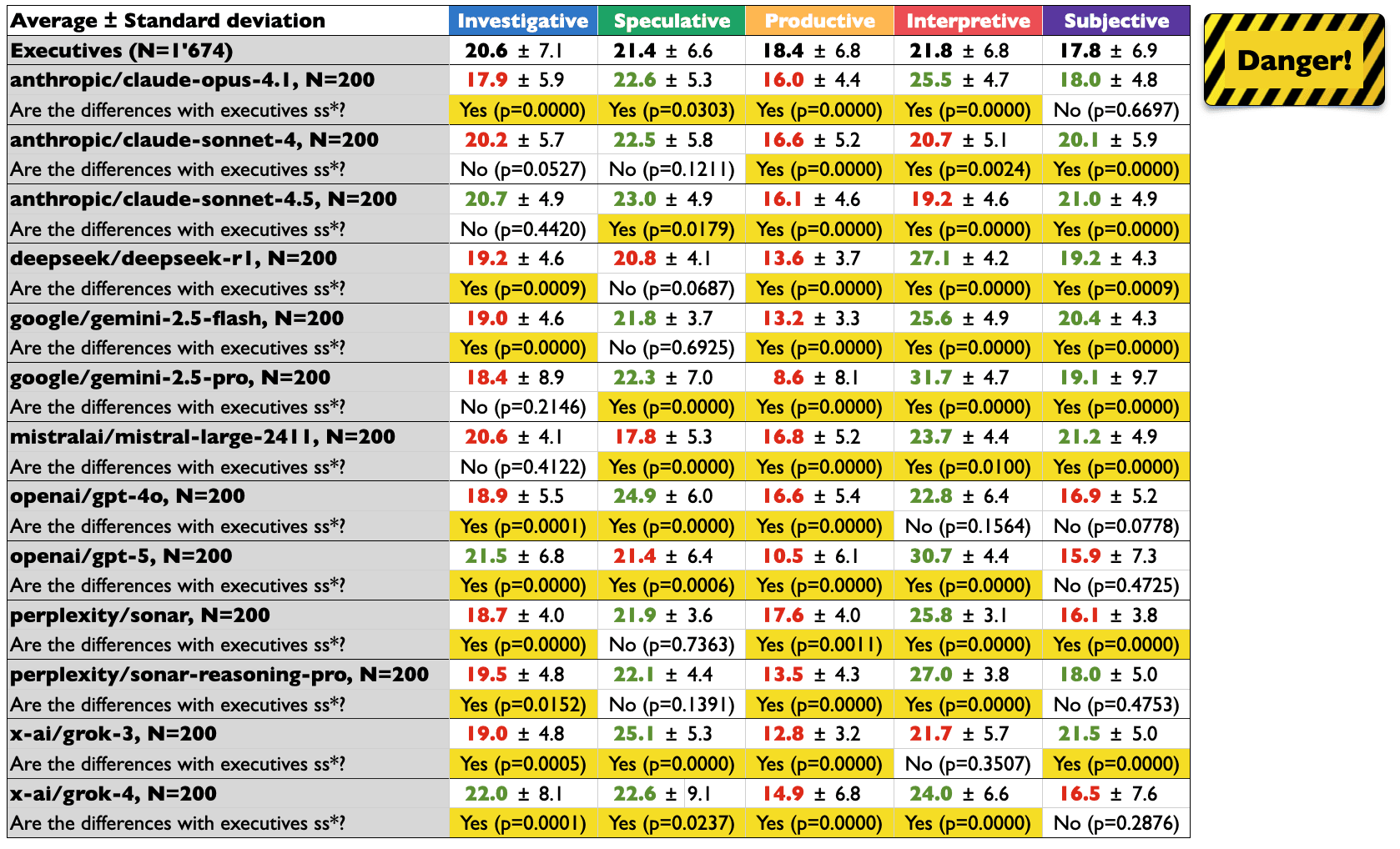
The questions mixes of LLMs differ drastically from those of executives as well as from those of other LLMs
So what?
A quick look at the table shows that all LLMs' mixes differ from executives' in at leas three question types; often four.
Some of these differences are polarized: all LLMs assign fewer points to productive questions than executives, and all but one assign more points to interpretive.
Another important distinction between executives and LLMs is that the latter have lower variance in their results than the former in most cases. This could imply that you're not going to get as much of a diversity of viewpoints from an LLM as you would from people.
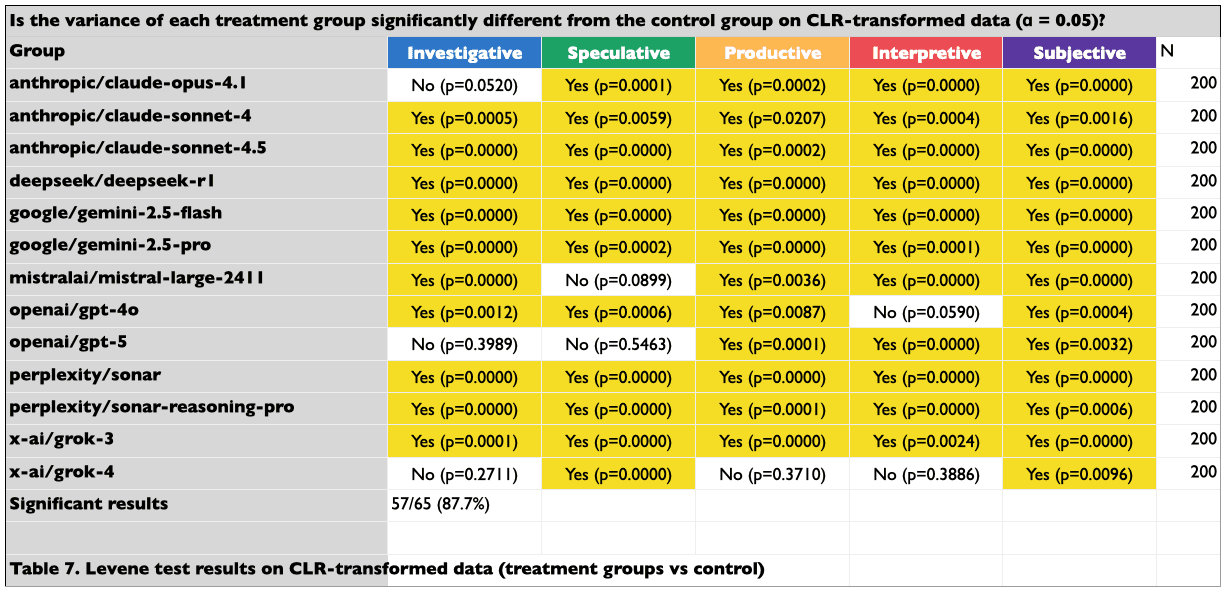
LLMs have lower variance in their results than executives in 88% of the cases
The long and short of it is that LLMs use different questions than executives do, which might be beneficial or not. The point is that their prioritization of rhetoric over evidential support together with their sycophantic style will have you believe that everything is under control where, in fact, you should be hyper vigilant on determining whether what your LLM is serving you is appropriate or not (see (Flyvbjerg, 2025)).

Let yourself be hypnotized, and find out… (credit: Disney)
So, yes, it's a jungle out there. And just as in Disney's 1967 Jungle Book, some actors (read LLMs) will happily hypnotize you unless you remain driving. How? Combat confirmation bias by asking yourself, "must I believe [this piece of information]?)
To find out more
The leader's question mix self assessment.
Chevallier, Arnaud, Frédéric Dalsace, and José Parra Moyano. "The Risks of Letting Ai Direct Conversations." HBR.org (March 2 2026).
Chevallier, Arnaud. HBR IdeaCast. Podcast audio. Are you asking the right questions?2024. https://podcasts.apple.com/lb/podcast/are-you-asking-the-right-questions/id152022135?i=1000652609745.
Chevallier, Arnaud, Frédéric Dalsace, and Jean-Louis Barsoux. "The Art of Asking Smarter Questions." Harvard Business Review 102, no. 3 (2024): 66–74.
Flyvbjerg, Bent. "AI as artificial ignorance." Project Leadership and Society (2025).
Comments